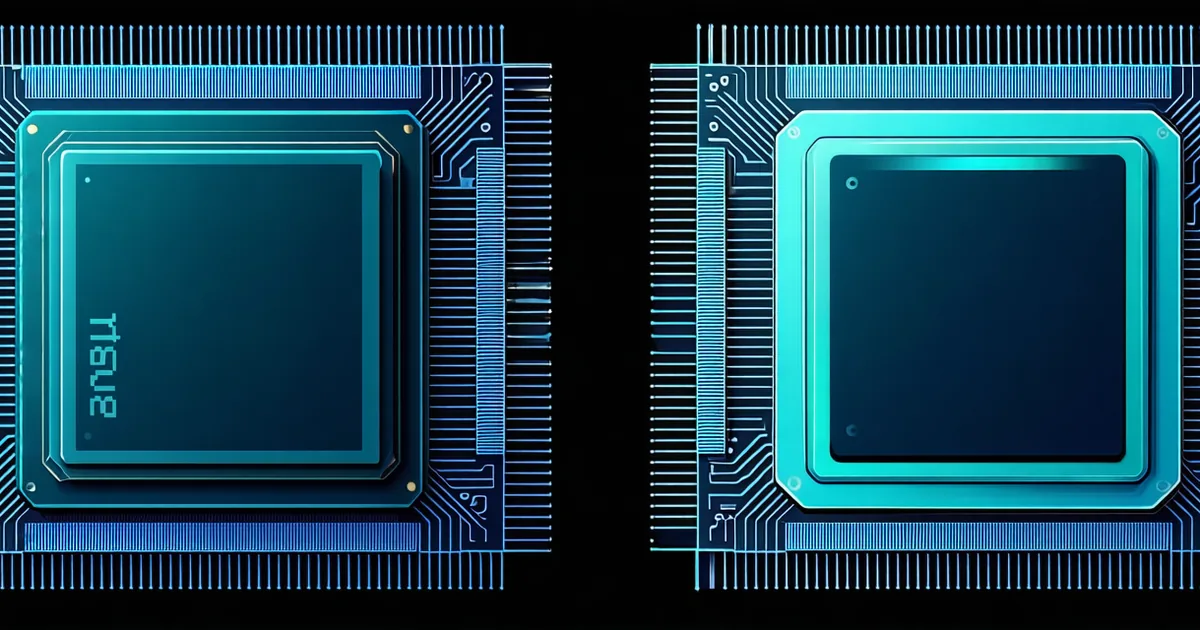
Platform engineers evaluating confidential computing for regulated AI workloads face a decision that looks deceptively simple on the surface: Intel TDX or AMD SEV-SNP? Both provide hardware-level memory isolation. Both produce attestation reports. Both are available on major cloud providers. The choice, however, has downstream implications for your attestation architecture, your key management integration, your performance profile, and your operational tooling. Getting the match right for your specific workload type is worth the analysis time.
This is a practical decision guide, not an exhaustive hardware spec comparison. The goal is to give platform engineers the framework to match their workload's characteristics to the right TEE substrate — and to flag where the differences actually matter versus where they are architectural noise.
The Core Architectural Difference: Process vs. VM Granularity
The most fundamental difference between Intel's TEE approaches and AMD SEV-SNP is the granularity of the protected domain. Intel SGX (the earlier approach, still widely deployed) protects at process granularity — the enclave is a protected region inside a user-space process. Intel TDX (the newer VM-level approach) protects at virtual machine granularity — the entire VM, including kernel, is inside the hardware-protected Trust Domain. AMD SEV-SNP also operates at VM granularity.
For regulated AI workloads, this distinction matters primarily in two ways. First, workload packaging: with SGX, you need to explicitly port your workload to run in the enclave context, typically using a library OS like Gramine or Occlum to provide POSIX compatibility. TDX and SEV-SNP, operating at VM level, can run an unmodified Linux VM with minimal or no code changes — the entire operating system and application stack simply runs inside the protected boundary. For teams deploying complex inference stacks (Python runtimes, ML frameworks, CUDA drivers), the VM-level approach substantially reduces the porting effort.
Second, trust boundary: in SGX, the host OS is outside the enclave and is not trusted. The enclave must be suspicious of all I/O from the host. In TDX and SEV-SNP, the VM's kernel runs inside the trusted domain, which simplifies the security model for many workloads but places more trust in the kernel itself. For inference workloads where the primary threat is the cloud provider's access to memory, both models are adequate. For workloads where the threat model includes a compromised kernel inside the VM, the SGX model with its smaller trusted computing base is more conservative.
Attestation Report Format Differences
Both Intel TDX and AMD SEV-SNP produce attestation reports, but the format and verification chain differ, and those differences have implications for your attestation verification infrastructure.
Intel TDX DCAP reports carry a set of measurement fields including MRTD (measurement of the initial TD firmware), RTMR fields (runtime measurement registers that can be extended by the TD during boot), and REPORTDATA (a 64-byte user-controlled field). The verification path uses Intel's DCAP certificate chain — quote verification can be done locally using cached collateral without a real-time call to Intel's Provisioning Certification Service, which is important for production throughput. Intel's DCAP approach is well-documented and has a mature verification library ecosystem.
AMD SEV-SNP reports carry a MEASUREMENT field (the launch digest of the initial VM image) and an REPORT_DATA field, with verification against AMD's ARK/ASK/VCEK certificate hierarchy. AMD's attestation model requires fetching the chip-specific VCEK certificate from AMD's KDS (Key Distribution Service) for each unique processor, which introduces a network dependency that needs to be handled in your attestation verification architecture — either by pre-fetching and caching VCEKs or by tolerating the KDS call latency in the verification path.
For key management systems that need to make attestation-based access control decisions at request time, the choice of TEE affects the latency and complexity of the verification step. Both are solvable, but Intel's cacheable collateral approach tends to be more operationally convenient for high-throughput inference workloads.
Cloud Availability and Instance Types
At the time of writing, both technologies are available on major cloud providers but with different instance type coverage and regional availability.
Intel TDX is available on 4th and 5th generation Xeon-based instances. The major cloud providers have deployed TDX-capable instances in a growing number of regions, with availability concentrated in production-tier regions rather than edge or specialty regions. TDX support in the hypervisor layer (KVM on Linux, Hyper-V on Azure) has been in upstream kernel trees since Linux 5.19 (initial) with ongoing improvements, and the cloud provider implementation layers are increasingly stable.
AMD SEV-SNP is available on EPYC Milan (3rd gen) and later processors. AWS has offered SNP-capable instances for a number of years. Azure Confidential VMs use AMD SEV-SNP on certain instance types. GCP has TDX-capable confidential VMs. The availability landscape changes with hardware refresh cycles, so verifying current instance availability in your target region is essential before making an architectural commitment.
For workloads with specific regulatory data residency requirements — particularly Japanese financial institutions that need to process in domestic cloud regions — current availability of confidential instance types in target regions is a practical constraint that may make the hardware choice for you, at least until broader regional rollout matures.
Performance Characteristics by Workload Type
The performance overhead of confidential computing comes primarily from memory encryption (the TME — Total Memory Encryption — layer) and from the attestation operations themselves. For CPU-bound inference workloads, the memory encryption overhead is typically in the 5–15% range depending on memory bandwidth pressure and access patterns. For GPU-accelerated inference, the GPU itself is not inside the TEE boundary in current hardware generations — the TEE protects the CPU-side preprocessing, key management, and result handling, with GPU memory remaining outside the hardware-protected region. This is an important limitation for large-scale transformer inference workloads that are fully GPU-bound.
For practical AI workloads in regulated settings: document processing, structured data inference, smaller LLM inference (7B–13B parameter range on CPU or modest GPU), and data transformation pipelines — the CPU-side overhead is generally acceptable. For workloads that require GPU memory confidentiality (e.g., protecting model weights from the cloud provider), the current hardware generation does not provide a complete solution, and the architecture needs to account for this limitation explicitly rather than assuming the enclave covers the full inference stack.
The Decision Framework
Given the above, here is a practical framework for matching workload type to TEE substrate:
Choose Intel TDX when: you need attestation verification at high throughput and want cacheable collateral without repeated KDS calls; your workload runs on Intel-equipped cloud instances in your target region; you have an existing investment in Intel's DCAP verification library ecosystem; or your attestation policy needs precise measurement of runtime state via RTMR extensions during the boot sequence.
Choose AMD SEV-SNP when: your target cloud region has EPYC-based instances but limited TDX availability; you are running on AMD hardware in a private data center with SEV-SNP-capable processors; or you need VM-level protection with a specific Linux kernel version that has better SEV-SNP driver maturity in your configuration.
Consider a substrate-abstraction layer when: you need to run the same workload across multiple cloud providers or regions where hardware availability is not uniform; you want your attestation verification logic to be hardware-agnostic; or your key management policy needs to express intent ("this workload is authorized") rather than hardware-specific measurement hashes that differ between TDX and SEV-SNP for the same logical workload.
The substrate-abstraction case is increasingly where production-grade confidential computing deployments land. Tying your key release policy to a specific hardware measurement hash that differs by CPU generation introduces operational fragility — a hardware refresh of the underlying instance type can invalidate your attestation policy. An intermediate abstraction that normalizes measurements and maps them to logical workload identities is the more durable architecture for long-running regulated AI deployments.
What Has Not Changed Between the Two
For all the architectural differences, the core security property is equivalent: neither the cloud provider's hypervisor nor the host OS can read the contents of the protected memory region. Both produce hardware-signed attestation reports verifiable against the CPU vendor's root certificate. Both prevent the cloud provider from accessing sensitive data in memory during computation, which is the compliance-relevant property for regulated AI workloads in banking, healthcare, and regulated enterprise.
The choice of TDX versus SEV-SNP is an operational and architectural decision, not a security-tier decision. For a platform engineer scoping a confidential-computing deployment for a regulated AI workload, the right starting point is: what instances are available in my target region today, what is the attestation verification integration complexity I can accept, and what is the realistic GPU acceleration story for my inference workload. Answer those questions and the hardware choice often follows directly.